Thursday, March 1, 2012

Electrical Engineering's Environmental Effects

     The environment may not seem like an electrical engineer's place.  However many things electrical engineers do have great effects on the environment.  Electrical engineers do work on power plants that use cleaner energy sources but many products from electrical engineers require large amounts of resources.  There is a conflict between producing technology at the sacrifice of some extra resources and lessening production to spare resources.  Many of today's electronics have become vital to daily life.  There is definitely a need for electrical engineers to produce things faster and better.  Electrical circuits during production need to be kept from any sort of impurities.  Gallons of water are used to wash chemicals off which contaminates the water.  This is one example of production at the cost of resources.  These processes do meet federal standards and are very important.  Its up to electrical engineers to put in extra effort to make these processes better than the bare minimum.

 Solar panels are one of electrical engineering's most resource-efficient energy producers.

     On the side of leaning more environmentally-friendly, many of electrical engineering's products use valuable resources.  If there is a more resource-efficient way to produce that is also more expensive then so be it.  The standards set are just enough to reduce waste and allow production to be high.  By being more environmentally aware electrical engineers can make a positive impact on the world while they perform their jobs.  Striving to be more efficient will better processes in the long run.  By minimizing waste electrical engineers conserve resources for future use and allow themselves more freedom in production.
     On the better and faster production side, electrical engineer's products have become absolutely necessary to today's world.  There is a high demand for the best electronics which means resources have to be used.  Processes such as making circuits are designed to be efficient already and the use of large amounts of energy and resources is required to make these products.  Electrical engineers can produce great amounts of energy and better electronics at the cost of great amounts of resources.  The things electrical engineers create have very important uses while the purpose of resources is to create these things.
     I believe the correct and ethical course of action is to lean more environmentally friendly.  The production of electronics is very important however the effects it has on the environment cannot be ignored.  I believe many electrical engineers strive for this but there is always the option to meet the minimum standards and focus only on production.  A major focus in electrical engineering is energy production so I believe it is important to hold environmentally-friendly processes in high regard.

Tuesday, February 28, 2012

Universities Win Grant to Develop Advanced Prosthetics

     Electrical engineering has allowed for some great advances in medical technology.  One of the most cutting edge and important technologies being developed is prosthetics.  Today's advanced prosthetics are controlled using electrical signals from muscles that control the prosthetic limb.  One of the major flaws in these prosthetics is that the person controlling the limb cannot feel what the object is or how much pressure they are applying.  The user often uses visual cues to judge this which can be very difficult.  The lack of sensory information is a major drawback in today's prosthetics.  Technology currently being developed can even take electrical signals created by the user's thoughts to control the prosthetic to a limited degree.  These issues being said, there is definitely room for improvement.
     In July of 2011 four universities were given a 1.2 million dollar grant to continue to develop prosthetics that, using a cap of electrodes, would allow users' to not only control prosthetics with thoughts but also give feedback on the object they are touching and how much force they are applying.  The universities were Drexel University, Rice University, University of Maryland, and the University of Michigan.  The four year project is being funded by the National Science Foundation's Human-Centered Computing program.  As good as this is, it is not enough.  This technology would greatly soften the physical and psychological effects of losing a limb.  Certainly the advanced prosthetics being developed would serve the user much better than ones readily available today.  There has been a recent large push in the area of advanced prosthetics from the Defense Advanced Research Projects Agency (DARPA) with United States soldiers returning from the wars in the Middle East.  Many soldiers have lost limbs serving their country and advanced prosthetics could make a great difference in returning to their day to day lives.  With this technology within reach and more relevant than ever, it is important to invest in it.  This grant is a step forward however much more will have to be done to make this technology affordable to those who need it. 
     A lost limb can not be truly replaced however with developing technologies prosthetics that return almost complete functionality could be just around the corner.  The number of people who could benefit from these prosthetics is not known but there are certainly enough to make this an important issue.  This is just one of the many important roles electrical engineering plays in the medical field and a fraction of electrical engineering's place in our modern times.  These universities receiving a grant is good news to hear but it shows that the funding is lacking.  Hopefully, this is the first of many grants to come.

Thursday, February 23, 2012

Graphene Transistors Review


     Transistors are a vital component in electrical circuits.  They amplify and switch electrical signals.  The first was built in 1947 and was made with germanium.  The first silicon transistor was created in 1954.  Since then the silicon transistor has found its way into just about every electronic.  The transistors invention was a major invention for electrical engineering and for all technology. Breakthroughs in transistor technology have lead to today's modern transistors which are low-cost and reliable.
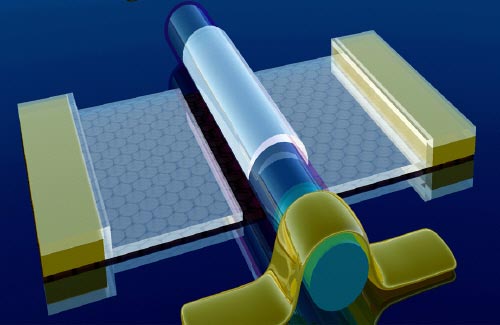
     Graphene transistors are possibly the next in line for powerful circuits.  The first graphene transistor was built in 2006.  This early attempt showed graphene's potential; however there were still bugs to work out.  In 2010 IBM made a graphene transistor that can operate at 100GHz.  Some of the fastest silicon transistors operate at 20GHz.  Graphene transistors are are also very small in comparison with silicon transistors.  Graphene transistors being as small as 10 to 15 atoms across while powerful silicon transistors get down to around 20 nanometers.  The major drawback on graphene transistors is that they cannot be turned off.  They always conduct even in an off state.  This greatly limits their current use to analog circuits.  Overall the graphene transistor is not a substitute for silicon.  Maybe with future innovations they can be applied on a larger scale, but today their strengths are eclipsed by their weaknesses.

Monday, February 20, 2012

An Inroduction to Electrical Engineering


 What is electrical engineering?

     Electrical engineering is the study and application of things electrical. This may sound vague however it summarizes the field about as precisely as can be done. Electrical engineering is very broad and continues to grow with technology. As with all engineering fields it is based on applying science for the advancement and betterment of humankind. Engineering fields are usually seen as problem-solvers. So the question is, what problems do electrical engineers solve? Supplying energy to homes, maintaining electrical systems, creating more powerful circuitry, developing pace makers and everything in between. As the world becomes more dependent on electronics the role of the electrical engineer will continue to grow.
      With so many variations in their work it is hard to describe the role of the average electrical engineer. What the engineer is interested in will change which the discipline he or she decides to pursue. Some may prefer medical applications while others will work with supplying energy. While their projects may set them apart most electrical engineers can be compared by a few aspects of their work. In general, electrical engineers work as a team. A good team of engineers will point out the flaws in each others' ideas and work together to produce the best solution. In electrical engineering the slightest slip in detail can cause a project to fail. This is why teams are such a common aspect of an engineer's career. Another comparison is an engineer's reason for pursuing the field. This is where problem-solving really becomes key. I have heard the term "an engineer's mind" many times and I think electrical engineers for the most part share a type of thought. It is not based on asking why something works but instead on how to make something work. This of course isn't true for every individual but it does say something about the field as a whole. Electrical engineers work to change the world around them.
      So what is the purpose of this field? Why is it relevant to everyone? Modern society is built on technology. Electrical engineers are not the only ones using the things they work on. Almost everyone depends on electrical engineering to keep today's world running properly. As the world advances electrical engineers become more and more vital. The demand for a better power supply, better medical equipment, more powerful systems, and also the latest and greatest gadgetry continues to grow. Electrical engineers collaborate with dozens of other fields to meet these demands to the benefit of both suppliers and the consumers.